
The medieval palaces — the buildings of the Picasso Museum
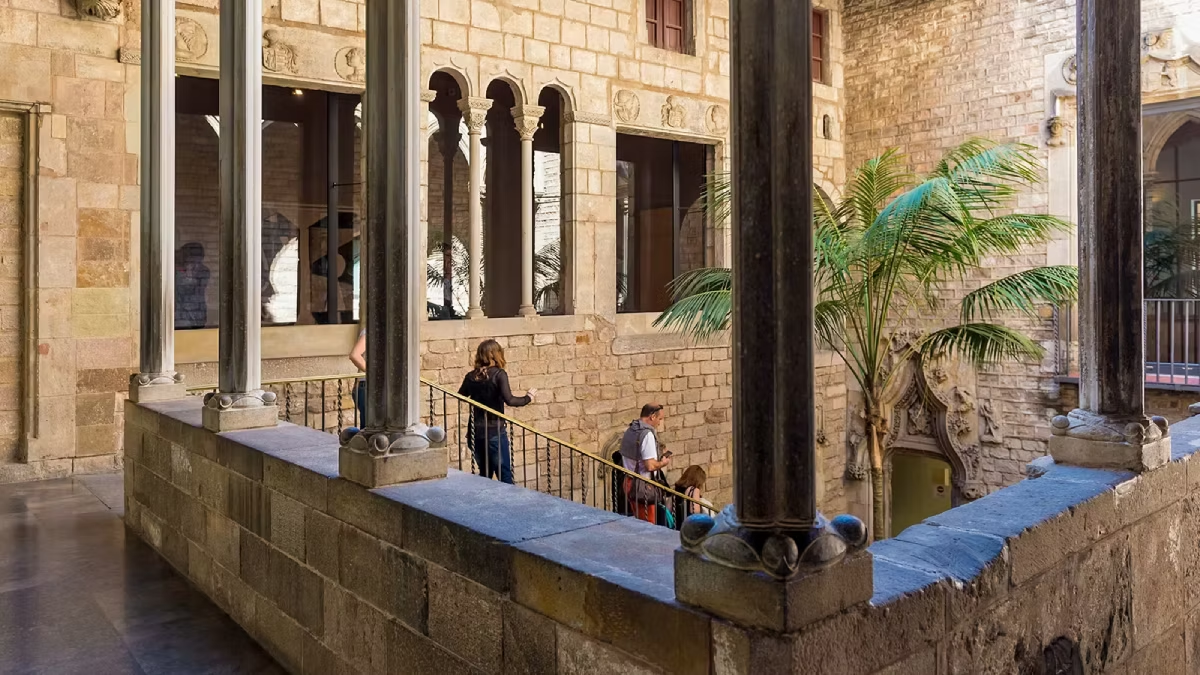
The Picasso Museum is not one purpose-built gallery but five adjoining medieval palaces on Carrer de Montcada — Palau Aguilar, Palau del Baró de Castellet, Palau Meca, Casa Mauri and Palau Finestres — built between the 13th and 15th centuries. The museum joined them together in stages between 1963 and 1999, and their Catalan Gothic courtyards and open-air staircases are as much a part of the visit as the paintings.
Most museums are designed around their collection. The Museu Picasso is the other way round: a collection has been fitted into a row of medieval merchant houses that were never meant to hold paintings at all. Walking between the galleries means walking between five separate buildings, each with its own courtyard, staircase and centuries of history before Picasso ever entered the picture.
That layout is unusual among major art museums, and it shapes how a visit feels — intimate, a little labyrinthine, and studded with architectural details that have nothing to do with the permanent collection hanging on the walls around them. This guide covers where the five palaces came from, how the museum grew into them, and what to look out for in the buildings themselves.
The Five Palaces at a Glance
| Palace | Address | Origins | Joined the museum |
|---|---|---|---|
| Palau Aguilar | Montcada 15 | 13th–14th century; acquired by merchant Berenguer d’Aguilar in 1400 | 1963 (opening site) |
| Palau del Baró de Castellet | Montcada 17 | 13th–14th century | 1970 |
| Palau Meca | Montcada 19 | 13th–14th century; owned by city councillor Jaume Caveller in 1349 | 1981–82 |
| Casa Mauri | Montcada 21 | Possibly 13th century; later a confectioner’s premises | 1999 |
| Palau Finestres | Montcada 23 | 13th century, built over Roman-era remains | 1999 |
Why Is the Museum Spread Across Five Buildings?
The Picasso Museum grew building by building rather than being designed from scratch. It opened in 1963 in a single palace, Palau Aguilar, and expanded next door as adjoining medieval houses on Carrer de Montcada became available — in 1970, then 1981–82, then 1999 — until it reached its current footprint of roughly 11,500 square metres across five palaces.
This piecemeal growth is the reason the museum feels less like a single gallery and more like a sequence of connected houses. Each expansion added not just wall space but an entire building’s worth of period features — courtyards, stone staircases, coffered ceilings — that the museum had to work around rather than design away. The result is 22 permanent exhibition rooms threaded through genuinely old domestic architecture, which is part of what makes the Barcelona Museum Pass worth using here rather than at a more conventional gallery.
Palau Aguilar — Where the Museum Began
Palau Aguilar, at Montcada 15, is the museum’s founding building and the one you enter through today. Its origins go back to the 13th and 14th centuries, and it takes its name from Berenguer d’Aguilar, a merchant who acquired the house in 1400 during Barcelona’s medieval trading boom. Its 15th-century courtyard, with a pointed-arch gallery and flamboyant Gothic stone carving, is one of the finest in the group, and its coffered ceilings and Renaissance doorway survive largely intact.
When the museum opened here in 1963 — with Jaume Sabartés, Picasso’s friend and secretary, instrumental in bringing it about, and Picasso himself donating works — Palau Aguilar was the entire museum. Everything that followed was built outwards from this single palace.
Palau del Baró de Castellet, Palau Meca and Casa Mauri
The next three palaces were annexed one at a time as the collection outgrew its first home. Palau del Baró de Castellet, at Montcada 17, joined in 1970; its ground floor has a four-pier brick vault, and its later neoclassical hall — added when the building was updated in the 18th century — sits oddly but appealingly alongside the medieval stonework elsewhere in the complex.
Palau Meca, at Montcada 19, followed in 1981, with its expansion formally opened in January 1982. It belonged to a city councillor named Jaume Caveller as early as 1349, and its courtyard and polychrome coffered ceilings, lit by a central oculus, are among the best-preserved medieval interiors in the museum. Casa Mauri, at Montcada 21, has murkier origins — possibly 13th century — and spent part of the 20th century as a confectioner’s premises before its 1999 integration into the museum. Its street façade, with decorative balconies and carved window thresholds, still reads as a working medieval house rather than a museum front.
Palau Finestres and the Temporary Exhibition Wing
Palau Finestres, at Montcada 23, is the newest addition to the museum’s footprint, joining in 1999 alongside Casa Mauri. It is also the oldest building of the five in parts — excavations found it sits over Roman-era remains — and it retains a fine coffered ceiling from the late 13th or early 14th century and a distinctive triple window with slender columns on its façade. Today Palau Finestres houses the temporary exhibitions programme, giving the museum a dedicated space for shows that rotate independently of the permanent collection next door.
Together, the five buildings give the museum roughly 11,500 square metres of exhibition space, laid out by architect Jordi Garcés across the 22 rooms that hold the permanent collection today.
Catalan Gothic Architecture: Courtyards and Staircases
The features that recur across all five palaces — courtyards and open external staircases — aren’t incidental decoration. They’re the defining elements of Catalan civic Gothic architecture, the style favoured by Barcelona’s merchant class during the city’s 13th- to 15th-century trading boom, when fortunes made in Mediterranean commerce were spent building substantial private houses along streets like Carrer de Montcada.
A typical house of this kind was built around a central courtyard open to the sky, with a stone staircase running up one side to reach the piano nobile — the grand upper floor where the family lived and entertained, above the working ground floor. You can see this pattern most clearly in Palau Aguilar’s courtyard, where the pointed-arch gallery and staircase together form the museum’s most photographed architectural corner, but variations recur throughout the complex, along with pointed arches, ribbed vaults and coffered wooden ceilings, some still bearing traces of their original polychrome paint.
Do the Buildings Affect Your Visit?
Yes, in mostly positive ways. Moving between five former houses means more changes of level, narrower connecting spaces and a less linear route than a purpose-built gallery, but it also means genuine medieval architecture at every turn — courtyards, staircases and ceilings that predate the collection by six centuries. The museum has added lifts so the route is largely step-free despite its age.
The trade-off is worth knowing before you go. The buildings can make the layout feel more like a sequence of rooms than an open floor plan, and Carrer de Montcada itself is a narrow, unevenly cobbled medieval street rather than a grand museum forecourt. If mobility is a concern, our accessibility guide has the specifics. For most visitors, though, the buildings add rather than detract — they’re one of the reasons a visit here feels different from a modern gallery, and one of several good reasons to judge whether the museum is worth it on more than the collection alone.
The setting also connects the museum to its neighbourhood. Carrer de Montcada was one of medieval Barcelona’s grandest addresses, and several of its other old merchant houses survive nearby. Exploring the El Born neighbourhood around the museum, and the wider list of things to do nearby, makes more sense once you understand that the museum itself is a piece of that same medieval streetscape rather than a modern insertion into it.
Frequently Asked Questions
How many buildings make up the Picasso Museum?
Five: Palau Aguilar, Palau del Baró de Castellet, Palau Meca, Casa Mauri and Palau Finestres, all adjoining on Carrer de Montcada. They were joined together in stages between 1963 and 1999 rather than built as a single structure, so the museum reads as a connected sequence of former houses rather than one continuous gallery.
When were the palaces built?
Most date from the 13th and 14th centuries, with Palau Finestres containing the oldest fabric, built over Roman-era remains. They were built during Barcelona’s medieval trading boom, when merchant families used fortunes made in Mediterranean commerce to construct substantial private houses along Carrer de Montcada.
Which palace did the museum open in first?
Palau Aguilar, at Montcada 15, was the museum’s sole building when it opened in 1963. Its 15th-century courtyard, with a pointed-arch gallery and Gothic stone carving, remains one of the museum’s architectural highlights and is the building you still enter through today.
Why does the museum have courtyards and outdoor staircases?
They’re standard features of Catalan civic Gothic architecture, the style used for grand private houses in medieval Barcelona. A central courtyard open to the sky, with an external stone staircase leading up to the main living floor, was the typical layout for a wealthy merchant’s house — and the Picasso Museum’s palaces preserve several fine examples.
Is the museum built over any older remains?
Yes. Palau Finestres, the newest addition to the museum (1999), was found during work to sit over remains from the Roman era, making parts of that building older than the medieval house above them. It’s now home to the museum’s temporary exhibitions.
Does visiting five old buildings make the museum harder to navigate?
It makes the route less linear than a modern gallery, with more changes of level between buildings, but it doesn’t make the museum inaccessible — lifts have been added so most of the route is step-free. Carrer de Montcada outside is a narrow, cobbled medieval lane, which is worth knowing before you arrive.
Are the palaces worth seeing even if you’re not that interested in Picasso?
Many visitors think so. The courtyards, staircases and ceilings are genuine medieval architecture in their own right, predating the collection by several centuries, and they’re included in your museum ticket at no extra cost. If historic buildings interest you as much as the art, that’s a reasonable part of your case for the visit being worth it.
Can I see the palaces’ exteriors without a ticket?
Yes. The façades of all five palaces are visible for free by walking along Carrer de Montcada, and it’s worth doing so before or after your visit to appreciate the street as a whole — several neighbouring buildings from the same period survive too. Seeing the interiors, courtyards and staircases, however, requires a museum ticket.
